
Home / Dirty Little Secrets / Part 4 of 5
SexismWomen are People Too?!
Content warning
This series addresses issues that may be traumatic for some readers. It contains graphic language and references to verbal abuse, misogyny, homophobia, violence and sexual assault.

So, I taught myself to backstitch!” Mark told his best friend when they were 12 years old; Brandon responded, “DUDE! What kind of homo are you?!” Although Mark didn’t mention his love for sewing again until many years later, he spent his free time practicing different techniques. He dreamed of being a fashion designer – but straight men didn’t do shit like that.
Mark studied automotive repair at his local vo-tech high school, and he got a great job in a shop after graduation. He wasn’t in love with his job, and when he told his girlfriend, Amber, about his passion for sewing a few years later, she emailed him a job posting for an automotive interior upholstery expert! Mark found a career that he loves – and he doesn’t get called a “fag” at every family holiday event since he’s still in a field for manly men.
Alright folks, it’s the fourth week of this, and if you haven’t read the content/trigger warning since week 1 (or never read it), we are going to request that you take a peek because shit’s about to get real. We’re hitting this head-on: SEXISM.
Sexism (noun): 1. prejudice or discrimination based on sex, especially: discrimination against women. 2. Behaviors, conditions, or attitudes that foster stereotypes of social roles based on sex.
“Man is defined as a human being and a woman as a female – whenever she behaves as a human being, she is said to imitate the male.”
- Simone de Beauvoir
Here’s the thing about sexism – it’s such a pervasive part of our heritage, our culture, our society, that most of us don’t even notice when it happens. Yeah, sure, of course, we notice the big stuff. Most of the quotes we’re sharing here are the obvious examples. We aren’t going to dive into the little stuff, not this time around, but we’re mentioning it here because it’s something to keep in mind:
For every “bitch,” “cunt,” or “suck my dick” that a woman hears in the workplace, there are dozens, maybe even hundreds, of microaggressions that plague her day-in, day-out. Some women stick it out, grow a thicker skin. Others quit. Death from a thousand cuts.
This article contains a great explanation of the differences between overt, covert and subtle sexism.
I’m learning to notice the little stuff, but it breaks from everything I’ve been taught my entire life. This was largely my experience, but it’s also been the experience of many girls and women who I’ve known at various points in life. When we’re little girls, we learn that being a girl means being less than a boy. That belief is reinforced in so many ways that we’ve touched on and ways that we couldn’t possibly address in such a limited space. But what about the insults and compliments that children are subjected to… and subsequently internalize? “He runs like a girl.” “She’s different than other girls.” “She’s got balls.” “He’s a pussy.” Being compared to females or anything feminine was a taunt, an insult. As children, we learned that being female was something to be ashamed of. Masculine comparisons- those are praise. Just to be male is worthy of praise. No, that doesn’t mean that every man has it easy. No one has it easy. It just means that whatever else is going on, a man isn’t chastised from his childhood, simply because he was born with the wrong genitalia.“What’s the worst possible thing you can call a woman? Don’t hold back, now. You’re probably thinking of words like slut, whore, bitch, cunt (I told you not to hold back!), skank. Okay, now, what are the worst things you can call a guy? Fag, girl, bitch, pussy. I’ve even heard the term ‘mangina.’ Notice anything? The worst thing you can call a girl is a girl. The worst thing you can call a guy is a girl. Being a woman is the ultimate insult. Now tell me that’s not royally fucked up.”
- Jessica Valenti, Full Frontal Feminism
But sexism happens to men too! Yes, it does. And we believe that’s complete bullshit, too. While 81% of surveyed women reported being victims of sexist jokes in the workplace, 63% of men also indicated feelings of unease when comments were made about their physical appearance (source).
And society is rife with examples of covert and subtle sexism that harms men: alimony, custody of children, corporal punishment, the acceptance of violence, and even the tolerance of prison rape. While women benefit from these instances of sexism in some cases, they are not the ones perpetuating the discrimination –
“When men suffer from sexism, then, they do so in much the same way women do. That is, they suffer not because women rule the world and are targeting men, nor because feminism has somehow triumphed and brainwashed all of our elected officials (most of them still men) into ideological misandry. Rather, men suffer because of the same gender role stereotypes that hurt and restrict women—though men, being of a different gender, fall afoul of those stereotypes in different ways. Women are supposed to be passive and domestic and sexual—so their employment options and autonomy are restricted and they are fetishized and targeted for sexual assault and exploitation. Men are supposed to be active and violent—so their claims to domestic rights are denigrated and violence directed against them is shrugged off as natural or non-notable” (source).
These inequities which harm men carry over from the cultural notion that a woman belongs in the home… an ideal that dates back to the days when women didn’t work outside the home, let alone have a successful career of her own. Feminists have fought against this stereotype for decades.
And research proves that most men do not agree with sexism. Research conducted by Catalyst indicates that 86% of men are personally committed to interrupting sexist behaviors when they see them at work! That’s awesome! What’s not so awesome? Only 31% feel confident in their ability to speak up, particularly in organizational climates where silence is the norm – Sound like any industries you might belong to?
“I have a sexual discrimination case against my old employer if that tells ya anything… I started off as an apprentice, worked there for two years and then (after I had been pushing for it for some time), they promoted me to flat rate. It started out okay, but they started to skip me for tickets and take my work… I was making substantially less than anyone else there because they refused to give me bigger jobs, even though I was just as capable and qualified as everyone else. That went on for MONTHS. I spoke up multiple times, but nothing got better. One day, they tried to pass this big truck off on me – the person who was next in line didn’t want it, and when I questioned them, they fired me. I had to deal with all kinds of shit on the regular there. The guys have multiple stalls in their bathrooms and a changing room too – the shop was made for them – but the women’s bathroom is just a private bathroom, so the guys kept sneaking in there to poop and would DESTROY the bathroom so I wasn’t able to go when I needed to. I asked everyone nicely to stop, but they didn’t. I put signs up, and they ripped them down… I taped them back up and then they covered the “wo” part of “women” so that it read ‘men.'”
- Maryland, 25 years old
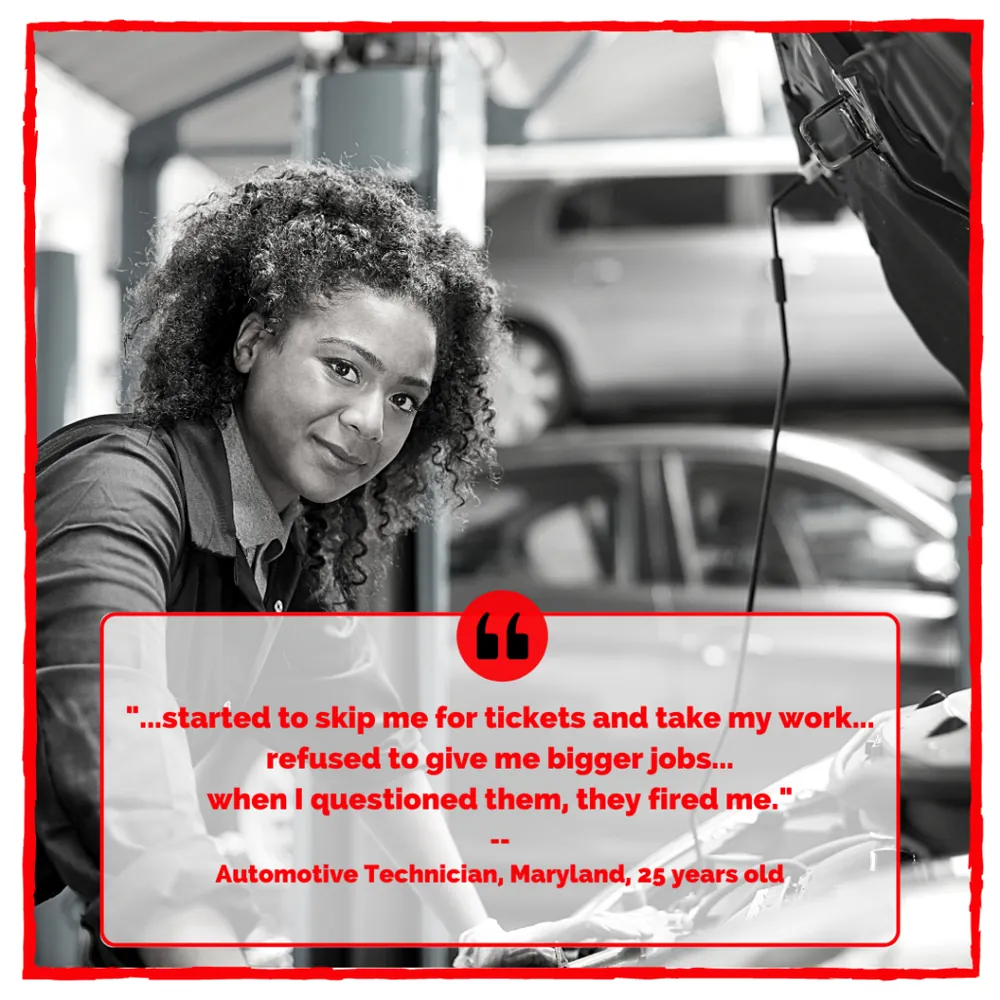
Chasidy reaction: Ya know, up until the “they fi#cfcf5a me” part, this sounded like the standard bullshit. I say that as a staunch feminist (in the weeks since I began these confessionals to y’all, I’ve become a lot more comfortable claiming that title…then I mixed it with rum) – but I also say that as a warning. I’m a generation older than this contributor, so I’m desensitized to a lot of discrimination. Less so than the women who came before me, the let-it-roll-off-your-back women. But I’m way less sensitive than these younger ladies. And I mean that as a compliment to them. Because they’ve recognized the patriarchal nonsense much sooner than I did. These young women, and the girls coming up behind them, were done before they could even spell fuck-the-patriarchy. They aren’t asking, cajoling, or begging – they are demanding equality; they aren’t putting up with the misogynistic shit anymore. Oh, also, the women’s bathroom sign? – like seriously, how childish is that?! My eyes just rolled so hard that I almost lost them.
S o, our Maryland friend is brave. She experienced sexism, and she called it out. And she was fired. And we wonder why women are reluctant to share their experiences with misogyny?
While sexism pervades the automotive industry 65% of women have been asked to perform lower level tasks, like note-taking and ordering food, which their male counterparts are not asked to do, nearly 30% believe the “automotive industry is no more sexist than any other industry;” 56% disagree. Nearly 80% of women have witnessed sexist behavior (from either gender) at industry conferences or off-site company gathering – at least once. Over 40% have witnessed it on multiple occasions (source).
Compared to 5% of men, 16% of women are subject to microaggressions at work (source). If you don’t know what microaggressions are, read about them here. But what microaggressions result in? Silence. Fear. Withdrawal.
Although most women experience subtle sexist behaviors on a regular basis, women have been programmed to ignore them, shrug them off, not make a fuss. Women who object to this treatment are subject to retaliation: criticism, threats, job loss, violence. Crybaby. Bitch. Slut. (Yeah, somehow it always comes back to that. Woman spills a glass of milk, and suddenly she’s sleeping with the whole damn neighborhood! *Sigh*)
According to this Forbes article, “When we call out sexism, it’s easy to be seen as shrill or preachy. ‘Crying sexism is essentially victimizing yourself,’ [writer Rachel Balik said], and in [male-dominated] industries like tech, that’s never a good position to be in. Instead, stress that any discriminating language, boy-girl-black-white-rich-poor, is simply uncool. Doing so with a ‘tough’ demeanor so as not to ‘scare’ the men with your feminine ways might also be key.” So, in order to be taken seriously, act like a man? Cool
“When handing out my resumes, one guy told me he “would never hire a girl to do a man’s job” and then proceeded to throw my resume in the garbage. I picked it out and told him I wouldn’t want to work for a piece of shit like him anyways. And thanks for letting me know what kind of person he was beforehand. I had been shot down so many times that day I was done being nice.”
- Ontario, Canada, 30 years old
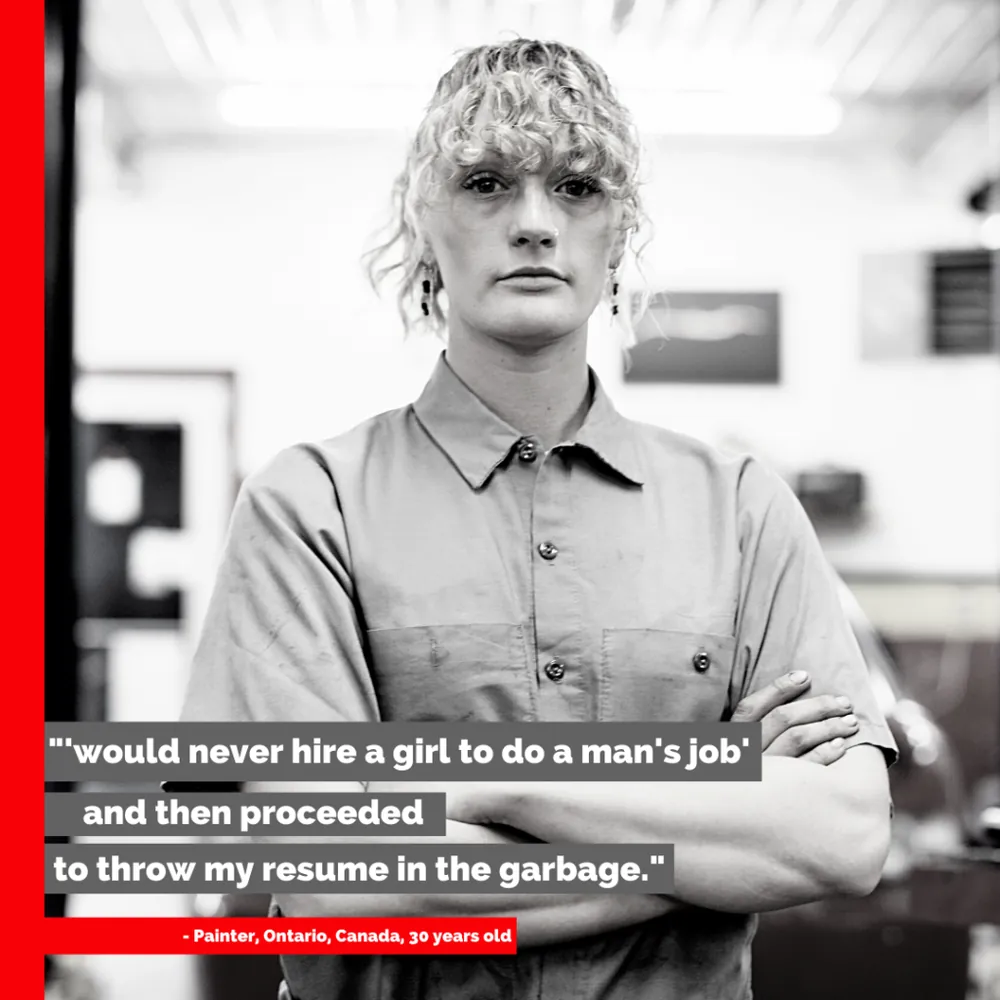
Chasidy reaction: How did that dude not get throat-punched?! Alright, you aren’t going to hire me, fine. You’re a sexist pig; good shit, I don’t want to work for you, twatwaffle. But how disrespectful is that? I’ve said it before, but put yourself in her shoes. “I’d never hire a #cfcf5a-head to do a brunette’s job.” “Oh, green-eyed people are lazy.” This is the shit that makes me question my attraction to men. Since I was a teenager, I’ve had this great magnet that says, “Women who want to be equal to men have no ambition.” OK, I’m going to be “super cringey” for all my little people by saying #Facts! And I don’t mean that women are superior to men. I mean that trying to be equal to any group is stupid – it indicates that you’re trying to be equal to the average. Who the hell wants to be average?!
S o, here’s a great example of the difference between diversity and inclusion. Folks get hung up on diversity because they’re worried that someone less qualified might get the job they want – because of their gender, skin color, etc. Ontario up here wasn’t looking to be hired because she was a woman. She was an automotive professional seeking a job.
Inclusion. When you INCLUDE every qualified candidate – regardless of gender, race or anything other than their education and/or skills – diversity happens naturally.
Now, let’s talk about this from another perspective: the female consumer’s. As a business, you need to sell – products, services, whatever. But people don’t buy those things. People buy people. And 90% of women surveyed by the Car Care Council in 2016 believed that “auto repair shop operators treat them differently because they’re women” (source).
Think about the businesses you’re uncomfortable walking into. Are those businesses that employ people who don’t look or think like you? It’s even more unnerving in a situation where you feel vulnerable, after an auto accident when you need to have your car repaired, for example. You want to feel safe, and being talked down to probably isn’t going to make you feel safe.
Female consumers ARE (basically) the consumer market. In the United States, women make or influence 83% of all purchases, including more than 80% of car purchases. They buy 65% of all new cars and 45% of light trucks and SUVs, plus they order 65% of all service work. Yet, three-quarters of women feel misunderstood by car marketers. “Make sure your dealership is welcoming women — not only as customers, but also as employees” (source).
The Global Leadership Forecast Study 2018 found companies with increased gender diversity and female representation are 1.4 times more likely to have sustained profitable growth (source).
“My tech school, who was also a manager at a big local collision shop, told me (in front of my classmates): “I’d never hire a woman, regardless of her talents, because of the distraction it would cause and the possibility of a lawsuit.” There have been many others, but that one stung the most because it almost made me quit. I’m glad I didn’t – I’ve been doing this for ten years now.”
- Pennsylvania, 32 years old
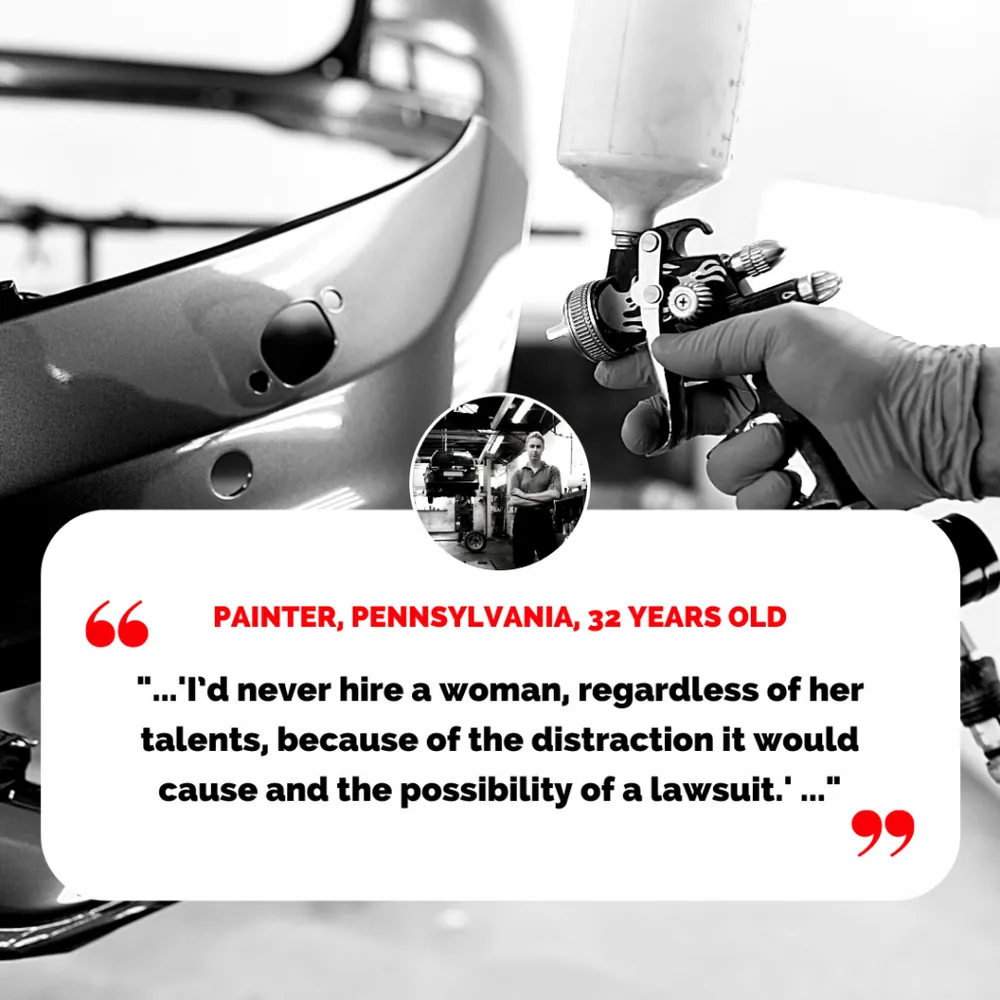
Chasidy reaction: I’m glad you didn’t quit, too, Pennsylvania! Y’all see that you nearly lost another one, right? Because of a teacher again. I know some pretty awesome automotive and collision instructors. I cannot imagine them saying anything like this, and I hope they wouldn’t. But someone is saying this shit to these young girls. Girls who are already going against the grain, who are hearing it from their families and friends. Also, how fucking stupid is that mentally? “Oh, I’m not going to hire the best because other people might be douchecanoes, and since I know I’m not willing to do shit about it, I might get in trouble.” GTFOH.
Let me point something out real quick – at industry conferences and training events, we talk a lot about attracting young people to the industry, how to engage them. But when we have that discussion, we are generally talking about young MEN, not young women. Because if we are going to talk about attracting young WOMEN to the automotive and skilled labor trades industry, we have to start by addressing the elephant in the room – sexism.
Why do we have to address sexism with this new generation when we didn’t address it with the ones who came before? Older gals know how to take a joke. These little girls are too uptight. No, they were just born to women who were already fed up; those women had mothers who were sick of it all, which they’d learned as the daughters or granddaughters of women who were barely considered human.
Now, is a lawsuit a genuine fear business owners have? Of course, it is, and with good reason. Last year alone (2020), 11,497 charges alleging sex-based harassment were filed with the EEOC, resulting in more than $65 million in settlements – and that doesn’t even include the charges filed with their Fair Employment Practice agency partners! The bulk of those (6,587) were charges for sexual harassment allegations, but we’ll get into that next week (source).
First off, those numbers represent a small percentage of women who experience sex-based harassment. The number who don’t report is astronomical. There are 69.23 million EMPLOYED women in the United States, so if we assume that all of these charges were brought by women (which is NOT accurate), that would mean that 1.66% brought charges. Yet, 42% of working women in the U. S. have experienced covert gender discrimination at work in eight specific categories, as outlined in this article. Subtle sexism, the kind that all women experience at some point in their lifetime, isn’t even a consideration in this context.
OK, also – let’s point out that obvious. Numero uno: Stop punishing the victim! Numero dos: Address the problem; check the Resources section for some companies that offer free or low-cost training on addressing unconscious bias.
But really, this teacher opened himself up to a lawsuit anyway, by opening his bigoted mouth. Because “I wouldn’t hire a woman” is sexism, folks. And it seems to be an all-too common occurrence. While 4% of men are rejected from jobs, women are rejected at nearly double that rate (7%) (source), which is even crazier since women must be more certain that they meet the qualifications of a job posting before they’ll even apply! (We talked about that last week in case you missed it.)
“‘You’re only liked and get big jobs because you’re something to look at.’ – Never mind I could do big jobs in half the time it took them! Same things when I was promoted to painter – only because I’m something to look at, seems like I can never win! The negative comments have always come from guys my age, never the older techs, but even though it’s hard, it’s definitely worth the bad days.”
- Canada, 23 years old
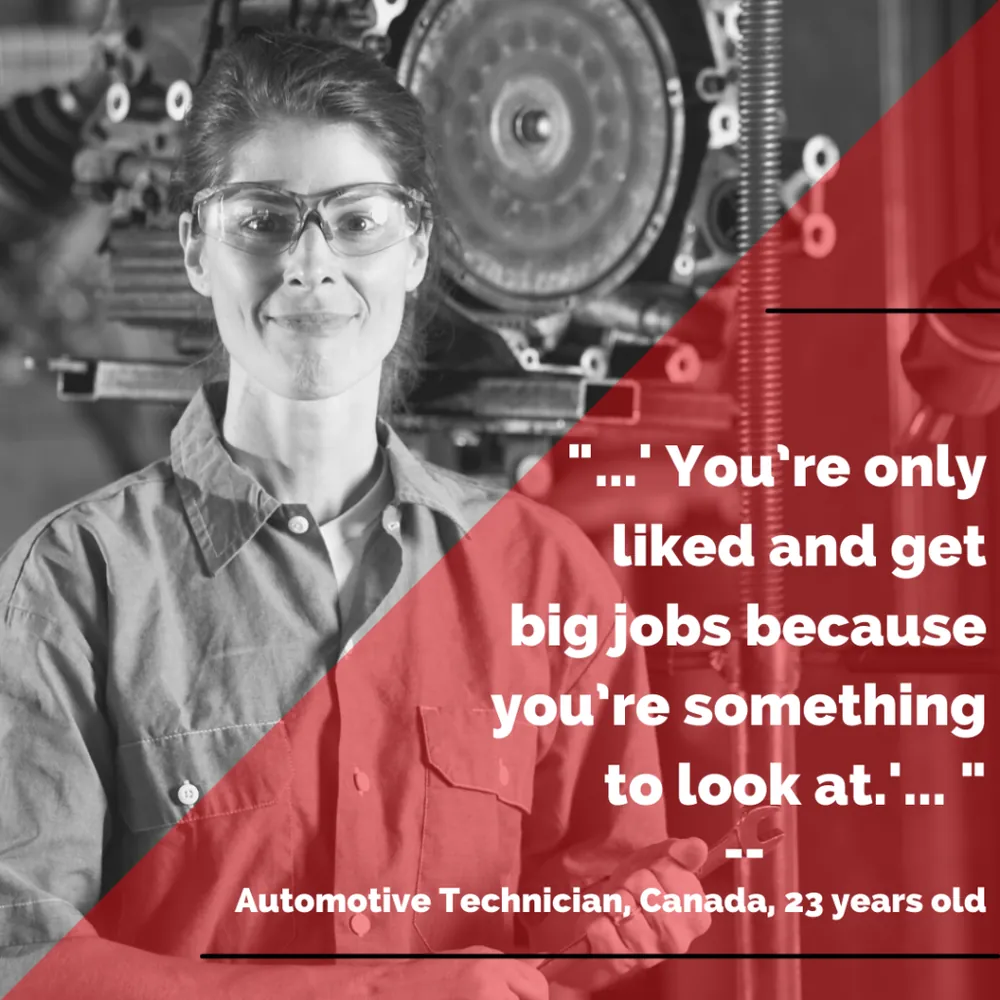
Chasidy reaction:I hate this on so many levels. I hate the fact that she was penalized for advancing. I hate the fact that she’s being relegated to her appearance. And I hate it that I’ve bought into this mentality, hund#cfcf5as if not thousands of times, that women are only valuable for how attractive they are. I’ve already talked about my mean-girl-phobia, but though I don’t consider myself “one of the pretty girls,” I also don’t think I’m hideous – plus I finally taught myself how to paint my face a couple years ago. So, while I know that I’m worth so much more than my face or my body, I also know that the way I’m perceived changes based on my appearance. Before taking my car to the shop last month, I took an extra 15 minutes to straighten my hair and slap some makeup on, had to make sure I looked presentable. After all, I had a concern with my car, and going to a shop meant dealing with men. The past few decades’ experience has taught me that men are more apt to pay attention to me if they don’t hate looking at me – no one’s interested in my problems when I assault their eyes in all my pre-caffeinated, troll-like glory!
T oxic masculinity (noun): a cultural concept of manliness that glorifies stoicism, strength, virility, and dominance, and that is socially maladaptive or harmful to mental health: Men and women both suffer when toxic masculinity perpetuates expectations that are restrictive and traumatizing.
There’s so much stupid controversary about this term… We’re going to take a minute here. The term “toxic masculinity” is not an attack against being a man; it’s perfectly fine to enjoy traditionally masculine things! Toxic masculinity is this hyper-machismo version of the “manliness” that some people, both male and female, believe to be indicative of a REAL MAN. “Toxic masculinity isn’t just about behaving like a man. Instead, it involves the extreme pressure some men may feel to act in a way that is actually harmful” (source).
It’s not having a beer with the guys, BBQing, hunting, fishing, growing a beard or enjoying traditionally masculine things. Toxic masculinity is treating women like sex objects. It’s using violence to resolve differences. It’s justifying men’s bad behavior with “boys will be boys.” It’s a denial of having emotions. It’s domestic violence, homophobia, sexism.
So, basically it’s that idea that, to be a MAN, you have to be the biggest, the strongest, the toughest guy out there. That’s bullshit, and it’s stupid. Here’s some examples of TV characters who demonstrate toxic traits, but if you check it out, you’ll notice that a lot of these guys are pretty likeable – except when they’re not. (Sidenote: “Sex Education” is a really cool teenybopper show that does a great job of addressing toxic masculinity and a lot of other sensitive topics.)
That’s one of the things that people forget when it comes to abusers: they can be very charming, which is why it’s so disarming when they’re not. We’re going to talk more about that next week in Sexual Harassment, but back to the topic at-hand.
Toxic masculinity is prevalent in male-dominated industries because when there’s one in a shop, it’s hard for the other guys to voice an objection (we’ll talk more about that in a bit). But what’s the effect?
Well, Chaya M. Milchtein shared her story in this article (which is definitely worth a read!), but here are some excerpts: “I loved my work, but hated the way my coworkers treated me… It didn’t matter their age, size, or position relative to mine, “baby” was mostly used as a way to infantilize and demean me… Many technicians have nude photographs hanging on their tool boxes. Each time I saw these photographs at work, I felt like a piece of meat—a person to be used sexually, but unworthy of being considered equal in the workplace. These small gestures add up. Women in the automotive repair industry are excluded from what is a boys club. Many leave. By 2018, after working as a service manager for three years at two different shops, I’d had enough. No job was worth the daily sexism.”
You can’t blame her; she’s right. Who wants to spend 40+ hours each week in a place where they’re constantly disrespected? Everyone deserves to be spoken to and treated with respect!
“I was told by my guidance counselor to put on a skirt and heels and go find an office job. Thirty-five years later, I fixed his Lexus at one of my shops, and he hugged me, saying he was never more proud – that I followed my dreams and not his advice.”
- Pennsylvania, 56 years old
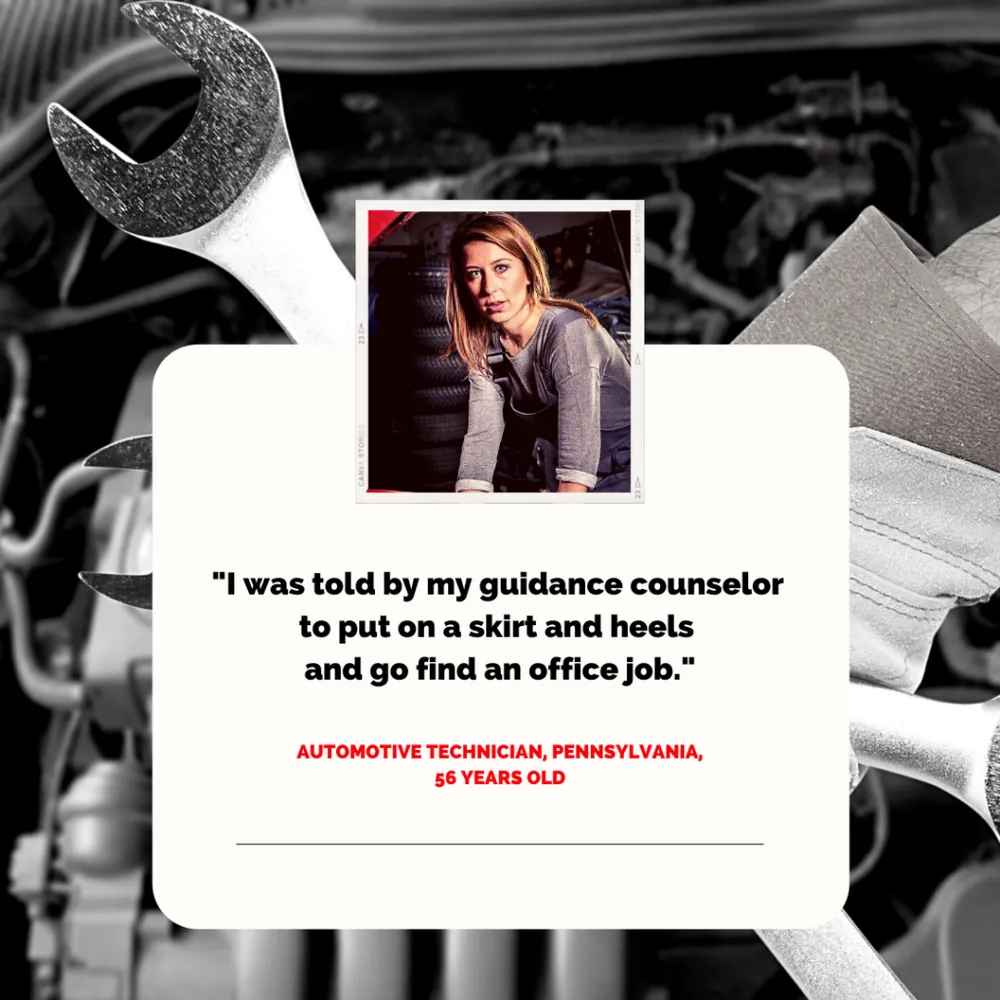
Chasidy reaction: One, ew. Skirt and heels? Office job?! Said the writer, I know, I know. But when I wear a skirt and heels, it’s because I choose to do so, not because it’s what I’m supposed to do as a woman. Ugh. Can I live? But on the plus side, this guidance counselor seems to have grown and realized the error of his ways – so that’s nice to see, and hopefully, it’s inspiring to some of y’all who aren’t sure that changing your mindset is p0ssible. I promise it is. It’s not always easy, and you’ll falter. I have thoughts pop into my head that don’t belong to me at times. They belong to a younger me, a me who was less educated. Sometimes, she intrudes, and I have to reeducate myself all over again. But I believe in equality, so I believe it’s worth the effort. It's an ongoing effort, but learning new things can be fun.
Yeah, she did! Yeah, he is! Okay, it’s awesome that she didn’t let her guidance counselor discourage her (though, I personally know that this is one tough lady). And it’s even more awesome that he eventually recognized that he was wrong. We’ve all been wrong; we’ve all changed as we’ve grown.
It’s time for the industry to grow, too. In their September 2020 survey, Deloitte and Automotive News asked over 700 automotive professionals, “Have you seen positive changes in the automotive industry’s attitude toward female professional employees in the last five years?” While 64% of men have seen some/significant positive change, just 39% of women felt the same; conversely, 35% of women report little change or worsening conditions, while only 13% of men believe it’s gotten worse.
So, who’s right? Well, who experiences the industry’s attitude toward females? Women do. Do things change, maybe even progress? Sure, thankfully, but slowly. So when things like #metoo happen, most guys check their behavior because they are open to learning (or maybe motivated by fear), but while comments may have been toned down, the implication is still there… maybe the complaint is now “ugh, chicks” instead of “fucking bitches!” But let’s also please acknowledge that the real bastards out there – they’ve been flying under the radar for years, and they continue to do it.
People often blame their bigotry on “how they were raised,” but that’s a pretty lame excuse. Are you telling me that you’ve never found a better way to do something as you got older? You’ve never found a new tool or new information that helped make you better, at something? Of course, you have – you’re a smart person, constantly seeking to improve yourself!
When an old way of doing something no longer serves you best, you unlearn it – and you learn something new. That’s what our society needs to do with sexism (and racism and homophobia and all bigotry). Let’s start here, though. Unlearn sexism; learn equality. The benefits of equality between the genders are numerous – for everyone.
“If you stand for equality, then you’re a feminist. Sorry to tell you.”
- Emma Watson
We cannot talk about women’s rights and experiences without mentioning the rights and experiences of transgender and non-binary people, as well. Reminder: People deserve to be treated with respect. They deserve to be accepted for who they are. They deserve to be safe. They deserve to BE, to exist. Period. If you need to educate yourself on how to be supportive of transgender people, read this or this.
While we have not yet had the opportunity to talk to any transgender or non-binary folks in the industry (but we would love to – hit us up!!) to share their experiences, a 36-year-old transgender woman (a woman who was assigned male at birth) from Florida shared her introduction to sexism as a female-presenting person. “At the beginning of my transition, I was working in retail, interacting with a lot of customers. Looking from down the aisle back then, I might have just appeared to be a gay emo boy with long hair, form-fitting clothes, and a touch of makeup. However, after months of estrogen, my body shop began to feminize, and my chest had a bit of observable curviness.”
“As that happened, it dawned on me that the ways in which customers called out to get my attention were becoming on average a bit less respectful – I had a sudden first-person awareness of the difference in how women and female-presenting people were treated, compared to men and male-presenting people. When I looked like a girlish boy, I was very rarely talked down to, but now that I looked like a boyish girl, I heard condescending tones more often. It’s odd to me that most people seemed to have no idea they were talking that way,” she said.
“I was simultaneously filled with excitement that I was starting to be seen as the woman I am… as well as a crushing sadness for how society teaches people to talk to women.”
An article published in “TIME” magazine also provides an interesting perspective on sexism, from the eyes of a transgender man (a man who was assigned female at birth).
Exploring how “experiences of trans men can provide a unique window into how gender functions in American society,” writer Charlotte Alter recounted her findings after over two dozen interviews with trans men and activists: “Over and over again, men who were raised and socialized as female described all the ways they were treated differently as soon as the world perceived them as male. They gained professional respect, but lost intimacy. They exuded authority, but caused fear. [They] reiterated how fundamentally different it is to experience the world as a man…Cultural sexism is often more visible to trans men, because most say they find it easier to be low-disclosure than trans women.”
Please, take a second and imagine being in that situation: How would you feel if you were suddenly treated differently by strangers, acquaintances, friends, even family – just because you wanted to be who you already are? Maybe you gained or lost some hair or fat… don’t we all do that during our lifetimes anyway? And whether I shave or not is none of your damn business, unless you’re in my bed (and even then, eh, I’ll take it under advisement), but I’m going to offer a suggestion that will bring you so much peace: stop worrying so much about what other people are doing with their own bodies or in their bedrooms. It’s none of your business.
The TIME article continued: “[Many] had no idea how rough women at work had it until they transitioned. As soon as they came out as men, they found their missteps minimized and their successes amplified. Often, they say, their words carried more weight: They seemed to gain authority and professional respect overnight. They also saw confirmation of the sexist attitudes they had long suspected: They recalled hearing female colleagues belittled by male bosses, or female job applicants called names.”
Others told Alter about male co-workers sexualizing female colleagues when women weren’t present, while James Gardner noted one of the professional benefits of maleness: “I don’t get as many calls to James correcting me. I’m the same person, but the men are less critical of James.”
There’s another side to transitioning though, because as a man, trans men are now viewed as threats. Tiq Milan told Alter: “If I start to get too close, I can feel her fear, I can feel that she’s getting upset. And it’s really just an indication of how dangerous this world is for women.” (If you don’t understand why men are viewed as a threat, stay tuned for the final installment of the Dirty Little Secrets of the Automotive and Skill Labor Trades Industries – Sexual Harassment, to be released on March 31st, 2021.)
OK, what is the fourth Dirty Little Secret?
You know that sexism is wrong. You do. And it’s also counterproductive to a healthy working environment. When women work in male-dominated environments, their most common coping mechanisms are “Distancing themselves from colleagues, especially other women; Accepting masculine cultural norms and acting like ‘one of the boys,’ which exacerbates the problem by contributing to the normalization of this culture; [and] Leaving the industry” (source).
Gender discrimination is also illegal, yet it’s prevalent in our society. “While initially these laws primarily protected women in the workplace, they are also designed to protect individuals who are discriminated against because of gender identity, including transgender status, and sexual orientation. In these times when non-heterosexual individuals are provided with the same protections as heterosexuals, equal employment laws apply to them as well” (source).
Now, obviously, sexism isn’t a problem that only impacts the automotive and skilled labor trades industries – it has infested society as a whole. But this is a great industry, filled with great people. We can do better; we can join progress and innovation – something this industry is pretty accustomed to. And we can make a better future – both in the industry and for our children. Sexism has a wide reach and a significant impact – on women and on men, on girls and boys, on everyone.
All people suffer from the negative effects of sexism. And all of us need to work together to stop it.
What can you do?
Educate yourself. It’s 2021, and most people recognize that overt sexism is unacceptable. Learn about subtle and covert sexism. And then acknowledge the damn problem. Treat people the way they deserve to be treated – which includes respecting differences in gender, race, culture, learning or physical ability.“Courage is like a muscle. We strengthen it by use.”
- Ruth Gordo
“Not only can women help to fill the thousands of open positions [in the automotive industry], but they can also become spokespeople and refer friends, family, and community to the career opportunities the automotive industry has to offer. Nude calendars and the bro club aren’t worth keeping women out” (source).
“Regardless of who is the subject of the joke or remark, all workers should be treated equally and deserve respect based on their level of skill and not their gender. Employers should act as advocates of the workplace culture, demonstrating that no form of sexism will be tolerated whether that is an indecent remark, joke or assigning tasks based on ridiculous notions of what a man or woman can do. Employers and management should use their platforms to see that sexism in the workplace becomes a thing of the past, creating a positive outlook for the future of business” (source).
Resources
Not all men. Absolutely not all men. But most men prefer staying silent, rather than challenging other men – but those misogynist men are never going to listen to a woman’s opinion! Here are some tips on how to talk to men about sexism and sexist behavior:
- How Men Can Confront Other Men About Sexist Behavior
- How to Talk to Sexist Men About Gender Inequality
There are many resources available on the topic of sexism which enables you to educate yourself, but if you’re interested in educating your staff so that you’ll be more comfortable hiring a diverse workforce without fear, these companies offer “Unconscious Bias” training that users can access at little to no cost:
Want to read more about how hiring more women can benefit your automotive business?
- Why We Need More Women in the Auto Industry
- Women auto mechanic careers
- Women Works in the Auto Repair Industry
If you want to learn more about Toxic Masculinity, here are a couple articles to check out:
And here are some organizations that may be able to provide useful information:
If you’re experiencing sex-based discrimination in the workplace, you can file a complaint here.
Bonus content
More voices
Additional Quotes
“A woman painter? They must’ve hired you to paint the pink ones!”
“Female mechanics, huh? Must be tough times!”
“How do you like screwing for a living?” (as I was working under the hood of his F-150).
- From Customers
You should be at home; women have no place in the shop.”
“Are you a real tech? I didn’t know they had any women.”
- From Co-workers / Industry Sales Reps